Derby shoe
A derby (UK: /ˈdɑːrbi/ ⓘ DAR-bee, US: /ˈdɜːrbi/ DUR-bee; also called gibson[1]) is a style of boot or shoe characterized by quarters, with shoelace eyelets, that are sewn on top of the vamp.[2] This construction method, also known as "open lacing", contrasts with that of the Oxford shoe.

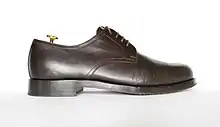
In American English the derby shoe may be referred to as a 'blucher', although technically the blucher is a different design of shoe where only eyelet tabs (not larger quarters) are sewn onto a single-piece vamp.
In modern colloquial English the derby shoe may be referred to as 'bucks' when the upper is made of buckskin.[3] "White bucks", or light-colored suede or buckskin (or nubuck) derby shoes, usually with a red sole, were long popular among the students and graduates of Ivy League colleges.[4] By translation, these shoes also became associated with elite law firms in America's eastern cities, especially New York and Boston, giving rise to the name "white-shoe firm" used to describe these prestigious legal institutions.[5]
The derby became a popular sporting and hunting boot in the 1850s. By the turn of the 20th century the derby had become appropriate for wear in town.[6]
See also
- List of shoe styles
References
- "definition of 'gibson' shoe?". Men's Clothing Forums. 2011-10-13. Retrieved 2024-02-09.
- Definition of Derby OxfordDictionaries.com
- "Dropping Knowledge: Bucks". GQ. 2013-05-01. Retrieved 2024-02-09.
- Safire, William (November 9, 1997). "On Language; Gimme the Ol' White Shoe". New York Times.
- "New Jersey State Bar Journal". New Jersey State Bar Association. June 25, 1957 – via Google Books.
- Flusser, Alan. Dressing the Man HarperCollins, 2002, pg 195.
| |||||||||
| Dress shoes |
| ||||||||
| Other shoes | |||||||||
| Wooden footwear | |||||||||
| Boots |
| ||||||||
| Sport-related footwear |
| ||||||||
| Folk footwear |
| ||||||||
| Historical footwear |
| ||||||||
| Shoe construction |
| ||||||||
| Hosiery | |||||||||
 List of shoe styles | |||||||||