List of cities in Ontario
A city is a subtype of municipalities in the Canadian province of Ontario. A city can have the municipal status of either a single-tier or lower-tier municipality. Prior to 2003, Ontario had minimum population thresholds of 15,000 and 25,000 for city status. Minimum population thresholds are no longer necessary for a municipality to brand itself as a city.
Ontario has 52 cities,[1] which together had in 2016 a cumulative population of 9,900,179 and average population of 190,388.[2] The most and least populous are Toronto and Dryden, with 2,794,356 and 7,749 residents, respectively.[2] Ontario's newest city is Richmond Hill, whose council voted to change from a town to a city on March 26, 2019.[3] Previous to that, Markham changed from a town to a city on July 1, 2012.[4]
History
Under the former Municipal Act, 1990, a city was both an urban and a local municipality.[5] Under that act, the Ontario Municipal Board (OMB) could change the status of a village or town, upon its request, to a city if it had a population of 15,000 or more.[5] The OMB could also incorporate a township as a city under the same conditions with the exception that the population requirements was 25,000 or more.[5] In either event, if located within a county, authorization by the Minister of Municipal Affairs was also required.[5]
In the transition to the Municipal Act, 2001, conventional municipal statuses and their associated population threshold requirements were abandoned. On December 31, 2002, every city that:[6]
- "existed and formed part of a county, a regional or district municipality or the County of Oxford for municipal purposes" became a lower-tier municipality yet retained its name as a city; and
- "existed and did not form part of a county, a regional or district municipality or the County of Oxford for municipal purposes" became a single-tier municipality yet retained its name as a city.
The current legislation also provides lower- and single-tier municipalities with the authority to name themselves as "cities", or other former conventional municipal status types such as "towns", "villages" or "townships", or generically as "municipalities".[7]
List
| Rank (2021) | Municipality | Municipal status | Population (2021) | Population (2016) | Change | Land area (km2) | Population density (/km2) |
|---|---|---|---|---|---|---|---|
1 |
Toronto | City | 2,794,356 | 2,731,571 | +2.3% | 631.1 | 4,427.8 |
2 |
Ottawa | City | 1,017,449 | 934,243 | +8.9% | 2788.2 | 364.9 |
3 |
Mississauga | City | 717,961 | 721,599 | −0.5% | 292.74 | 2,452.6 |
4 |
Brampton | City | 656,480 | 593,638 | +10.6% | 265.89 | 2,469.0 |
5 |
Hamilton | City | 569,353 | 536,917 | +6.0% | 1118.31 | 509.1 |
6 |
London | City | 422,324 | 383,822 | +10.0% | 420.5 | 1,004.3 |
7 |
Markham | City | 338,503 | 328,966 | +2.9% | 210.93 | 1,604.8 |
8 |
Vaughan | City | 323,103 | 306,233 | +5.5% | 272.44 | 1,186.0 |
9 |
Kitchener | City | 256,885 | 233,222 | +10.1% | 136.81 | 1,877.7 |
10 |
Windsor | City | 229,660 | 217,188 | +5.7% | 146.02 | 1,572.8 |
11 |
Richmond Hill | City | 202,022 | 195,022 | +3.6% | 100.79 | 2,004.4 |
12 |
Burlington | City | 186,948 | 183,314 | +2.0% | 186.12 | 1,004.4 |
13 |
Oshawa | City | 175,383 | 159,458 | +10.0% | 145.72 | 1,203.6 |
14 |
Greater Sudbury | City | 166,004 | 161,531 | +2.8% | 3186.26 | 52.1 |
15 |
Barrie | City | 147,829 | 141,434 | +4.5% | 99.01 | 1,493.1 |
16 |
Guelph | City | 143,740 | 131,794 | +9.1% | 87.43 | 1,644.1 |
17 |
Cambridge | City | 138,479 | 129,920 | +6.6% | 112.99 | 1,225.6 |
18 |
St. Catharines | City | 136,803 | 133,113 | +2.8% | 96.20 | 1,422.1 |
19 |
Waterloo | City | 121,436 | 104,986 | +15.7% | 64.06 | 1,895.7 |
20 |
Thunder Bay | City | 108,843 | 107,909 | +0.9% | 327.77 | 332.1 |
21 |
Brantford | City | 104,688 | 98,563 | +6.2% | 98.65 | 1,061.2 |
22 |
Pickering | City | 99,186 | 91,771 | +8.1% | 231.10 | 429.2 |
23 |
Niagara Falls | City | 94,415 | 88,071 | +7.2% | 210.25 | 449.1 |
24 |
Peterborough | City | 83,651 | 81,032 | +3.2% | 64.76 | 1,291.7 |
25 |
Sault Ste. Marie | City | 72,051 | 73,368 | −1.8% | 221.99 | 324.6 |
26 |
Sarnia | City | 72,047 | 71,594 | +0.6% | 163.90 | 439.6 |
27 |
Norfolk County | City | 67,490 | 64,044 | +5.4% | 1597.68 | 42.2 |
28 |
Welland | City | 55,750 | 52,293 | +6.6% | 81.16 | 686.9 |
29 |
Belleville | City | 55,071 | 50,716 | +8.6% | 247.15 | 222.8 |
30 |
North Bay | City | 52,662 | 51,553 | +2.2% | 315.53 | 166.9 |
Gallery
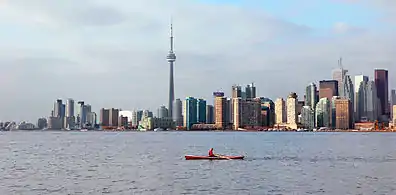 Toronto is Ontario's capital and Canada's largest city
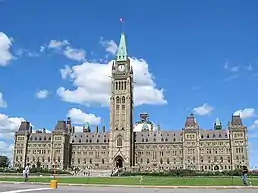 Ottawa is Canada's capital and Ontario's second largest city
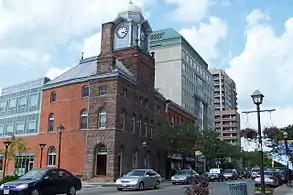 Downtown Brampton
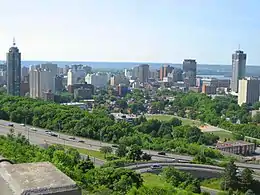 Skyline of downtown Hamilton
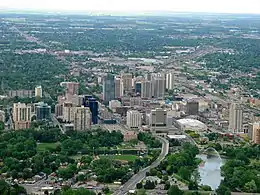 Skyline of downtown London
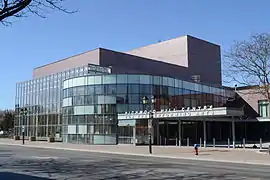 Richmond Hill Centre for the Performing Arts in Richmond Hill, Ontario's newest city
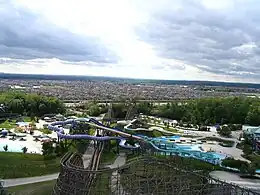 Vaughan as viewed from Canada's Wonderland
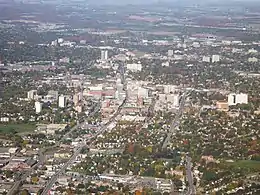 Downtown Kitchener
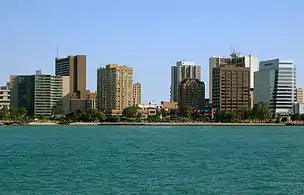 Downtown Windsor
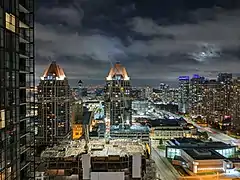 Downtown Mississauga
See also
- List of communities in Ontario
- List of municipalities in Ontario
- List of towns in Ontario
- List of township municipalities in Ontario
- List of villages in Ontario
Notes and references
Notes
- The Barrie census metropolitan area (CMA) is formed around the City of Barrie.
- The Brantford CMA includes the City of Brantford as well as the County of Brant, which is a single-tier city.
- The City of Cambridge, as well as the cities of Kitchener and Waterloo, form parts of the Kitchener–Cambridge–Waterloo CMA.
- Dryden is Ontario's smallest city by population.
- Greater Sudbury is Ontario's largest city by area. The Greater Sudbury CMA is formed around the City of Greater Sudbury.
- Hamilton is Canada's tenth-largest city. The Hamilton CMA includes the cities of Burlington and Hamilton.
- The City of Kitchener, as well as the cities of Cambridge and Waterloo, form parts of the Kitchener–Cambridge–Waterloo CMA.
- The London CMA includes the cities of London and St. Thomas.
- Mississauga is Ontario's largest lower-tier city.
- The City of Niagara Falls, as well as the cities of Port Colborne, St. Catharines, Thorold and Welland, form parts of the St. Catharines–Niagara CMA.
- The Oshawa CMA is formed around the City of Oshawa.
- Ottawa is Canada's capital and fourth-largest city. The Ontario portion of the Ottawa–Gatineau CMA includes the cities of Clarence-Rockland and Ottawa.
- Pembroke is Ontario's smallest city by area.
- The Peterborough CMA is formed around the City of Peterborough.
- Richmond Hill is Ontario's newest city, adopting the name on March 26, 2019.
- The City of St. Catharines, as well as the cities of Niagara Falls, Port Colborne, Thorold and Welland, form parts of the St. Catharines–Niagara CMA.
- The Thunder Bay CMA is formed around the City of Thunder Bay.
- Toronto is Ontario's capital and Canada's and Ontario's largest city by population. The Toronto CMA includes the cities of Brampton, Markham, Mississauga, Pickering, Richmond Hill, Toronto and Vaughan.
- The City of Waterloo, as well as the cities of Cambridge and Kitchener, form parts of the Kitchener–Cambridge–Waterloo CMA.
- The Windsor CMA is formed around the City of Windsor.
References
- "List of Ontario Municipalities". Ontario Municipal Affairs and Housing. September 21, 2012. Archived from the original on February 28, 2013. Retrieved January 3, 2013.
- "subdivisions (municipalities) and designated places, 2016 and 2011 censuses – 100% data". Statistics Canada. 8 February 2017.
- "Richmond Hill Becomes a City". RichmondHill.ca. Retrieved 27 March 2019.
- "Markham to change from town to city". CBC News. May 30, 2012. Retrieved January 3, 2014.
- "Municipal Act, R.S.O. 1990, Chapter M.45". Service Ontario. Retrieved June 29, 2013.
- "Municipal Act, S.O. 2001, Chapter 25". Service Ontario. Retrieved June 29, 2013.
- "The Municipal Councillor's Guide". Ontario Ministry of Municipal Affairs and Housing. Retrieved June 29, 2013.
- "Population and dwelling counts, for Canada, provinces and territories, and census subdivisions (municipalities), 2011 and 2006 censuses (Ontario)". Statistics Canada. May 28, 2012. Retrieved January 3, 2013.
- "Population and dwelling counts, for Canada, provinces and territories, and census divisions, 2011 and 2006 censuses (Ontario)". Statistics Canada. January 30, 2013. Retrieved June 27, 2013.
Subdivisions of Ontario | |
|---|---|
| Counties | |
| Districts | |
| Regional municipalities | |
| Single-tier municipalities | |
| Separated municipalities | |
| Regions | |
| |


| Provinces | |
|---|---|
| Territories | |
| |
