Minor Arcana
The Minor Arcana, sometimes known as Lesser Arcana, are the suit cards in a cartomantic tarot deck.
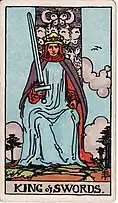
Ordinary tarot cards first appeared in northern Italy in the 1440s and were designed for tarot card games.[1] They typically have four suits each of 10 unillustrated pip cards numbered one (ace) to ten, along with 4 court cards (face cards). Tarot games are still widely played in central and southern Europe and French Tarot is the second most popular card game in France after Belote.
By contrast, cartomantic tarot cards emerged in France in the late 18th century popularised by occultists such as Etteilla. The terms "Major" and "Minor Arcana" originate with Jean-Baptiste Pitois (1811–1877), writing under the name Paul Christian.[2]
In their contemporary versions, the Minor Arcana are often illustrated—a convention popularized by the Rider–Waite tarot in 1910. Used in a tarot card reading in conjunction with the Major Arcana, the cards of the Minor Arcana suggest subtleties and details, and signify day-to-day insights.[3]
Cartomantic Tarot cards derived from Latin-suited packs typically have a Minor Arcana of 56 cards, with 14 cards in each suit: Wands (alternately batons, clubs, staffs, or staves), Cups (chalices, goblets, or vessels), Swords (or blades), and Pentacles (coins, disks, or rings). The four court cards are commonly: page, knight, queen, and king. Some variations have princess and prince cards replacing the page and knight cards; the historical Visconti-Sforza Tarot expands the court with two additional cards: the damsel and the mounted lady. While the historical Tarot of Marseilles contains 56 cards, later packs based on the French suits of clubs (♣), hearts (♥), spades (♠), and diamonds (♦) have only three court cards per suit, with a jack (also known as a page or knave) in addition to the queen and king.
Symbolism
In divinatory, esoteric and occult tarot, the Minor Arcana are believed to represent relatively mundane features of life. The court cards may represent the people whom one meets.
Each suit also has distinctive characteristics and connotations commonly held to be as follows:[4]
| Latin suit | French suit | Element | Class | Faculty |
|---|---|---|---|---|
| Wands, batons, clubs, staves | ♣️ Clubs | Fire | Artisans | Will and creativity |
| Swords, blades | ♠️ Spades | Air | Nobility and military | Reason or logic, wisdom, and intellect |
| Cups, chalices, goblets, vessels | ♥ Hearts | Water | Clergy | Spiritual matters, or emotions and love |
| Pentacles, coins, disks, rings | ♦ Diamonds | Earth | Merchants | Material matters, or possessions and career |
Gallery of card suits
Illustrations from the Rider–Waite tarot, the most popular amongst English speakers, divided by suit and arranged in ascending order of face value.
Cups
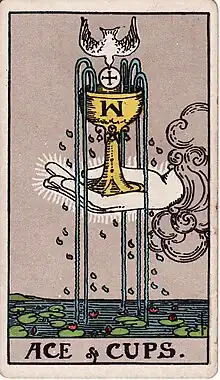
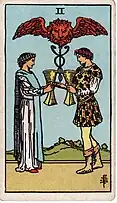 Two of Cups
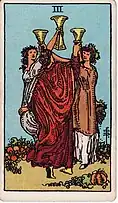 Three of Cups
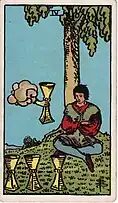 Four of Cups
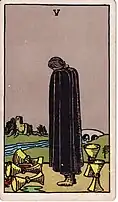 Five of Cups
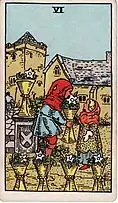 Six of Cups
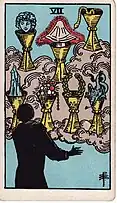 Seven of Cups
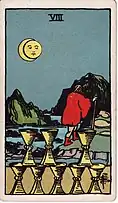 Eight of Cups
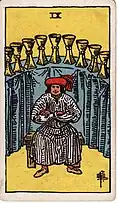 Nine of Cups
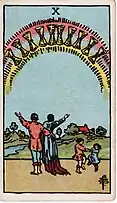 Ten of Cups
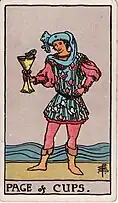 Page of Cups
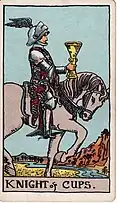 Knight of Cups
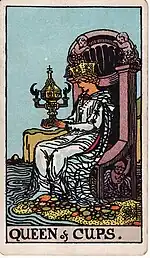
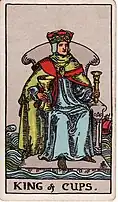 King of Cups
Pentacles
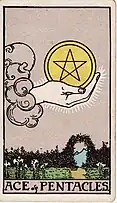 Ace of Pentacles
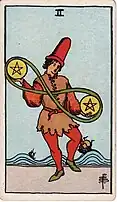 Two of Pentacles
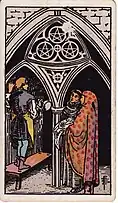 Three of Pentacles
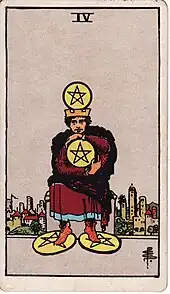 Four of Pentacles
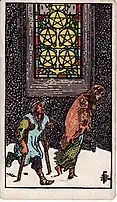 Five of Pentacles
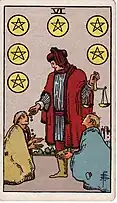 Six of Pentacles
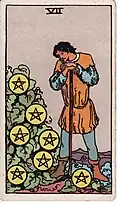 Seven of Pentacles
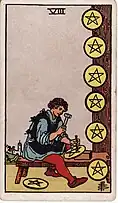 Eight of Pentacles
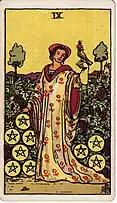 Nine of Pentacles
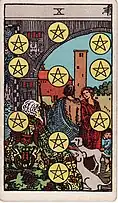 Ten of Pentacles
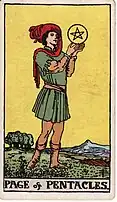 Page of Pentacles
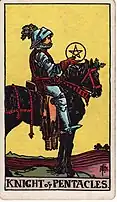 Knight of Pentacles
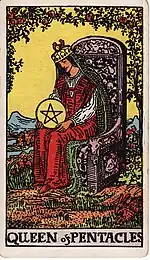
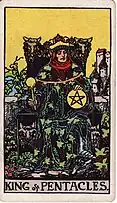 King of Pentacles
Wands
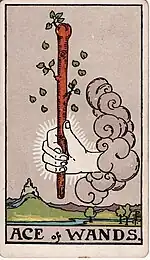
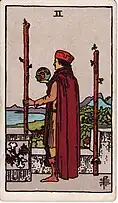 Two of Wands
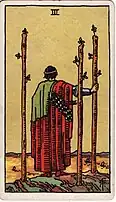 Three of Wands
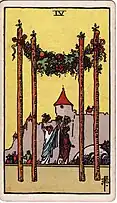 Four of Wands
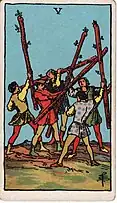 Five of Wands
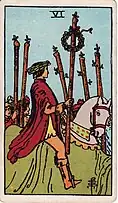 Six of Wands
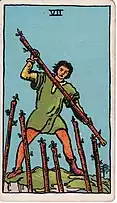 Seven of Wands
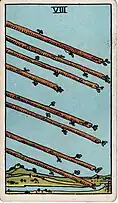 Eight of Wands
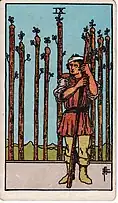 Nine of Wands
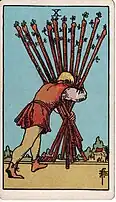 Ten of Wands
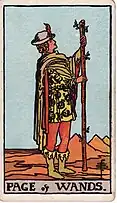 Page of Wands
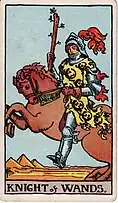 Knight of Wands
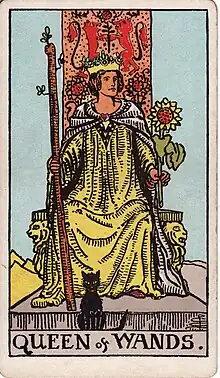
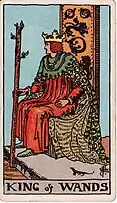 King of Wands
Swords
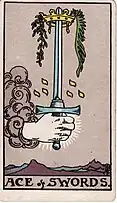 Ace of Swords
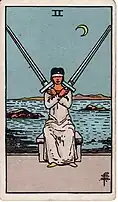 Two of Swords
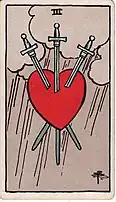 Three of Swords
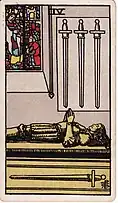 Four of Swords
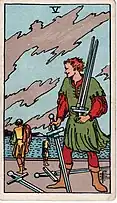 Five of Swords
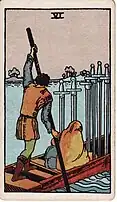 Six of Swords
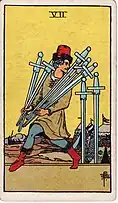 Seven of Swords
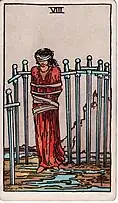 Eight of Swords
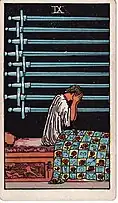 Nine of Swords
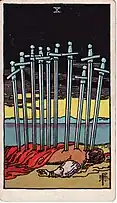 Ten of Swords
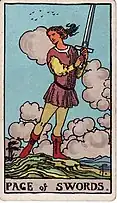 Page of Swords
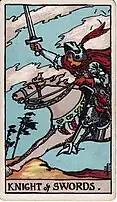 Knight of Swords
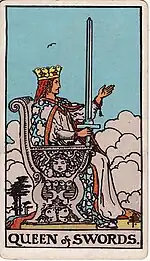
- King of Swords
Planetary associations
In the Order of the Golden Dawn, number cards are associated with planets, corresponding to their placement in Kabbalah.[5]
- Threes - Saturn
- Fours - Jupiter
- Fives - Mars
- Sixes - Sun
- Sevens - Venus
- Eights - Mercury
- Nines - Moon
- Tens - Earth
References
- Husband, Tim. "Before Fortune-Telling: The History and Structure of Tarot Cards". The Met Museum. The Met Museum. Retrieved 18 September 2022.
- Ronald Decker, Thierry Depaulis, and Michael Dummett. A Wicked Pack of Cards. The Origins of the Occult Tarot. New York. St. Martin's Press, 1996
- "The Minor Arcana Tarot Cards". Tarot.com. Archived from the original on 11 December 2014. Retrieved 11 December 2014.
- Dee, Jonathan (2002). "Introduction to the Minor Arcana". In Liz Dean (ed.). Tarot, An illustrated guide. Silverdale Books. ISBN 1-85605-685-6.
- McCann, David. Houlding, Deborah (ed.). "Mercury in Myth & Occult Philosophy". The Traditional Astrologer. Nottingham, UK: Ascella. Archived from the original on 2019-09-27. Retrieved 2019-09-27.
External links
 Media related to Minor Arcana at Wikimedia Commons
| Occultists |
| ||||||||
|---|---|---|---|---|---|---|---|---|---|
| Major Arcana numbered cards |
| ||||||||
| Minor Arcana suit cards |
| ||||||||
| Decks |
| ||||||||
| Related |
| ||||||||
| |||||||||